 “When words are difficult using prayer beads to give shape to prayer”
There are times when prayer comes easily. Gratitude finds its own language; familiar words feel alive; the heart and the mind seem to move together. Then there are other times when even beginning feels difficult.
Grief, uncertainty, illness, conflict and long periods of waiting can leave us with more feeling than language. We may want to pray but have no idea what to say. We may start a sentence and lose it halfway through. Sometimes silence feels peaceful, but sometimes it simply feels empty.
In Reconciliation After Long-Term Estrangement, Amanda Libbers considers the fragile and often painful early stages of reconnecting with a family member after a long estrangement. It is a subject that calls for care and humility. I would not presume to offer instruction on reconciliation itself. What I can offer, as someone who makes and uses prayer beads, is a small reflection on what may help when the heart is carrying more than words can hold.
Christians have prayed with beads in different forms and traditions for centuries. A Catholic rosary, Anglican prayer beads or a simple string of prayer beads may each have a different structure, but they share something very human: they give the hands a place in prayer.
Anglican prayer beads have a distinctive 33-bead arrangement: four groups of seven “week” beads, separated by four cruciform beads, together with a single invitatory bead and a cross. They are also used beyond Anglicanism, while the wider term “Protestant prayer beads” is sometimes used for similar devotional forms. The beads do not require one fixed set of words; they can carry prayers drawn from Scripture, liturgy or a person’s own Christian tradition.
This matters because we are not minds floating separately from our bodies. We breathe, touch, tire and become restless. When thoughts circle or scatter, the movement from one bead to the next can provide a gentle boundary. We do not have to solve everything. We only have to remain with this prayer, this breath and this bead.
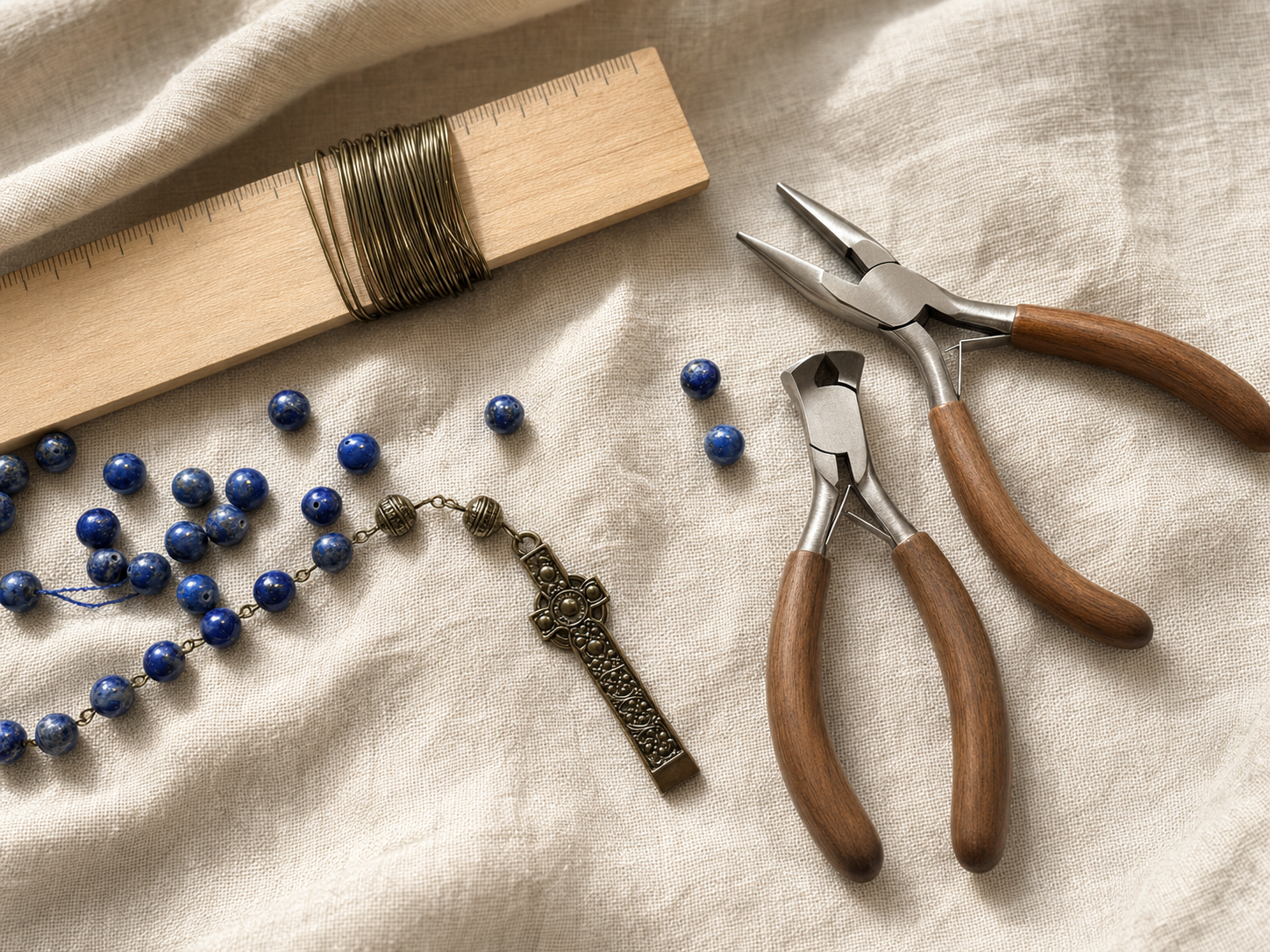
At my workbench, prayer beads begin as ordinary materials: wood or stone, cord, wire and metal. I thread them, knot them and check each connection. Yet their deeper meaning can only develop once they leave the bench and enter somebody’s life. They are held beside hospital beds, carried on journeys, kept in pockets and reached for in the night. They become worn and familiar through use. Their value is not that they remove pain, but that they can accompany us through it.
Prayer beads are not a way of forcing an answer from God. They cannot make a difficult situation tidy or guarantee the outcome we hope for. They simply offer a form when our prayer feels formless.
The practice can be very simple. Choose a short prayer that can bear repetition: “Lord, have mercy”, “Jesus, be near” or “Give me grace for today”. Hold the first bead, breathe, say the words slowly and move to the next. If your attention wanders, return without scolding yourself. If emotion interrupts you, let it. There is no prize for reaching the final bead and no failure in stopping early.
Repetition is sometimes mistaken for saying something without meaning it. In lived prayer, it can be quite the opposite. We repeat the words because we need time to enter them. Their meaning may change as we move: a plea may become a surrender, gratitude may appear beside grief, or nothing may seem to happen at all. The prayer is still prayer.
I am increasingly convinced that faithfulness is often less dramatic than we imagine. It is not always certainty, eloquence or spiritual confidence. Sometimes it is simply the willingness to return. We lose our way, become distracted or tired, and begin again—not perfectly, but honestly.
When words are difficult, we do not need to manufacture impressive ones. One bead, one breath and one small prayer may be enough. We can place what we cannot yet explain into the hands of God, trusting that silence is not absence and that God already knows what has not been said.
ABOUT THE AUTHOR
Fiach OBroin-Molloy is the maker and apiarist behind Paisley Honey in Scotland, where he creates rosaries and prayer beads intended to be held, carried and prayed with.